Have you ever considered the long-term implications of choosing a data type for something as fundamental as time representation in a system?
Some design decisions, even when reasonable at the time, can persist for decades and eventually become limitations.
The Issue
The Year 2038 problem refers to a limitation in systems that represent time using a signed 32-bit integer.
Unix time counts the number of seconds since 1 January 1970 00:00:00 UTC. In a 32-bit signed integer representation, the maximum value is:
- 2,147,483,647 seconds, which corresponds to 19 January 2038, 03:14:07 UTC
One second later, incrementing the maximum value causes an integer overflow. The value wraps to -2147483648 in a 32-bit signed integer representation, effectively moving the clock into the negative range.
Depending on system interpretation, this may result in incorrect dates, potentially as early as 1901.
While many modern systems are not affected, legacy software, embedded devices, and long-lived industrial systems that still rely on 32-bit time representations may experience incorrect or undefined behavior if not updated.
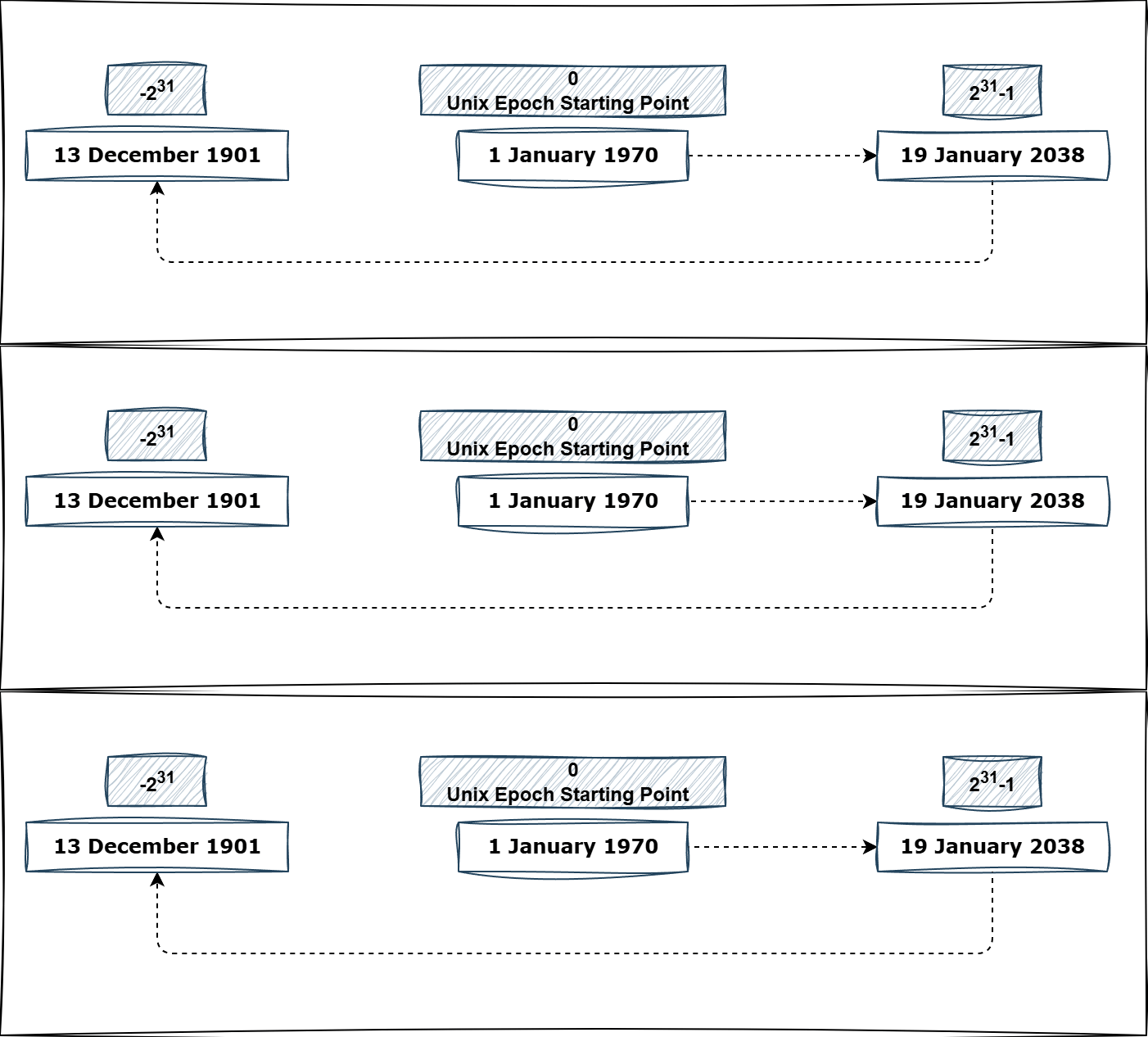
Origin and Cause: The 32-bit Trade-off
The Year 2038 problem is not a bug in a single system, but a limitation born from a pragmatic engineering trade-off.
When the Unix system was developed in the late 1960s and early 1970s, developers needed a simple, universal way to represent time. They chose a numeric counter representing seconds since the Unix epoch (1 January 1970). However, hardware and memory were extremely limited in that era. Using a 32-bit integer to store this value was highly efficient—it allowed for fast arithmetic operations and conserved memory.
But why a signed 32-bit integer (which halves the positive range)? The developers needed to represent dates before the Unix epoch (like 1969) for file creation times and historical data. If they had used an unsigned 32-bit integer, the limit would have been pushed out to 2106, but representing past dates would have been difficult.
Was this overflow an accident? Not entirely. The engineers who designed Unix were well aware of the mathematical limits of a 32-bit integer. However, in the early 1970s, the year 2038 was nearly 70 years away—an eternity in an era where hardware was expected to be replaced every few years. Long-term overflow scenarios were simply not a primary design concern.
The real problem is that good software exceeds its intended lifespan. These 32-bit assumptions became deeply embedded in the C time_t data type, operating systems, and hardware architectures. As Unix-based systems expanded, the foundation exceeded the assumptions, turning a temporary trade-off into a global compatibility issue.
Range of a signed 32-bit integer:
-2,147,483,648 to 2,147,483,647
How Can We Avoid It?
There is no single universal fix. The solution depends on system architecture, compatibility requirements, and other constraints.
Modern mitigation strategies include:
- Using
64-bittime representations (int64_tor equivalent), which greatly extend the representable range - Migrating systems and libraries away from
32-bittime dependencies - Auditing embedded systems and legacy software where updates are difficult
- Designing systems with long-term data type constraints in mind
32-bit vs 64-bit Perspective
32-bit systems: 1970 → 2038 (limit is soon to be reached)
64-bit systems: 1970 → far beyond what we can imagine
We are still early, right ?
Actually, no. Some systems that interact with future dates are already hitting the 2038 wall:
- Databases.
- Financial Systems.
- Web Servers.
- etc.
Conclusion
The Year 2038 problem is not just a limitation of integer overflow. It is a reminder that software systems often outlive the assumptions under which they were designed.
Choices such as data types, system architecture, and representation formats can have consequences decades into the future. While they may seem minor at the time, they can eventually become structural limitations.
Designing systems with long-term constraints in mind is essential—especially for infrastructure expected to persist across generations.